| Home | > | List of families | > | Polypodiaceae | > | Microsorum | > | scolopendria |
Microsorum scolopendria
Selected images: Click on each image to see a larger version and details of the record View all images (8)
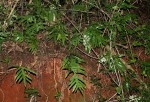
Photo: Petra Ballings
Old power station, Nyahode river, road to Rusitu
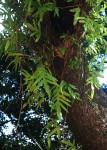
Photo: Petra Ballings
Haroni river, Haroni-Rusitu
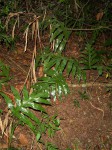
Photo: Petra Ballings
Katiyo Tea estates, Honde Valley
Detailed records: Display species records QDS maps by: Google Maps Point records by Google Maps
Species details: Click on each item to see an explanation of that item (Note: opens a new window)
| Synonyms: |
Drynaria phymatodes (L.) Fée Phymatodes scolopendria (Burm. f.) Ching Pleopeltis phymatodes (L.) T.Moore Polypodium phymatodes L. |
| Common names: | |
| Frequency: | |
| Status: | |
| Description: |
Rhizome widely creeping, up to 1 cm in diameter; rhizome scales dark brown, lanceolate, tapering to a point, finely toothed, later lost and surface becoming white. Fronds widely spaced, coriaceous, glabrous. Stipe up to 45 cm long, stramineous to light brown, glabrous. Lamina up to 60 × 30 cm, deltate-ovate to broadly oblong in outline, deeply pinnatifid into 4-8 pairs of lobes and a terminal segment. Lobes up to 15 × 3 cm, narrower in fertile than in sterile fronds, narrowly oblong to linear in outline, apex pointed, margins entire to somewhat wavy. Sori 2-3 mm in diameter, in 1-2 regular to irregular lines on either side of the costae, slightly sunken into the lamina, prominent on the upper side, exindusiate, with nonpeltate paraphyses. |
| Notes: | Can be confused with Microsorum scandens that has the sori placed in 1 row on each side of the costule and up to 20 pairs of pinna and with *Phlebodium aureum that has dense golden brown rhizome scales and 8-16, up to 35 pairs pinna. |
| Derivation of specific name: | skolopendrion: a millipede; a comparison alluding to the creeping rhizome with its rootlets. |
| Habitat: | In low-altitude areas below the eastern border mountains in Brachystegia woodland and riverine forest. |
| Altitude range: (metres) | 320 - 920 m |
| Worldwide distribution: | From eastern South Africa to Mozambique, eastern Zimbabwe, tropical Africa, Madagascar, Comoro and Mascarene islands, Sri Lanka, southeastern Asia, China, Australia and Polynesia. |
| Zimbabwe distribution: | E |
| Growth form(s): | Epiphyte, lithophyte, terrestrial. |
| Endemic status: | |
| Red data list status: | |
| Insects associated with this species: | |
| Spot characters: | Display spot characters for this species |
| Images last updated: | Monday 30 April 2012 |
| Literature: |
Burrows, J.E. (1990). Southern African Ferns and Fern Allies. Frandsen, Sandton. Pages 200 - 202. (Includes a picture). Chapano, C. & Mamuto, M. (2003). Plants of the Chimanimani District National Herbarium and Botanic Garden, Zimbabwe Page 44. As Phymatodes scolopendria Crouch, N.R., Klopper, R.R., Burrows, J.E. & Burrows, S.M. (2011). Ferns of Southern Africa, A comprehensive guide Struik Nature Pages 552 - 553. (Includes a picture). Da Silva, M.C., Izidine, S. & Amude, A.B. (2004). A preliminary checklist of the vascular plants of Mozambique. Southern African Botanical Diversity Network Report No. 30 Sabonet, Pretoria Page 13. Jacobsen, W.B.G. (1983). The Ferns and Fern Allies of Southern Africa. Butterworths, Durban and Pretoria. Pages 314 - 316. (Includes a picture). Mapaura, A. & Timberlake, J. (eds) (2004). A checklist of Zimbabwean vascular plants Southern African Botanical Diversity Network Report No. 33 Sabonet, Pretoria and Harare Page 8. Roux, J.P. (2001). Conspectus of Southern African Pteridophyta. Southern African Botanical Diversity Network Report 13 Pages 101 - 102. (Includes a picture). Roux, J.P. (2009). Synopsis of the Lycopodiophyta and Pteridophyta of Africa, Madagascar and neighbouring islands Page 161. Schelpe, E.A.C.L.E. (1970). Pteridophyta Flora Zambesiaca Pages 153 - 155. As Phymatodes scolopendria (Includes a picture). Siebert, S. & Mössmer, M. (Editors) (2002). SABONET Southern Mozambique Expedition 2001; Provisional Plant Checklist of the Maputo Elephant Reserve (MER) and Licuati Forest Reserve (LFR) SABONET News 7(1) Page 28. |
Other sources of information about Microsorum scolopendria:
Our websites:
Flora of Caprivi: cultivated Microsorum scolopendriaFlora of Mozambique: Microsorum scolopendria
Flora of Zimbabwe: cultivated Microsorum scolopendria
External websites:
African Plants: A Photo Guide (Senckenberg): Microsorum scolopendriaBHL (Biodiversity Heritage Library): Microsorum scolopendria
EOL (Encyclopedia of Life): Microsorum scolopendria
GBIF (Global Biodiversity Information Facility): Microsorum scolopendria
Google: Web - Images - Scholar
iNaturalist: Microsorum scolopendria
IPNI (International Plant Names Index): Microsorum scolopendria
JSTOR Plant Science: Microsorum scolopendria
Mansfeld World Database of Agricultural and Horticultural Crops: Microsorum scolopendria
Plants of the World Online: Microsorum scolopendria
Tropicos: Microsorum scolopendria
Wikipedia: Microsorum scolopendria
| Home | > | List of families | > | Polypodiaceae | > | Microsorum | > | scolopendria |