| Home | > | List of families | > | Asphodelaceae | > | Aloe | > | ballii |
Aloe ballii
makurupiniensis
Selected images: Click on each image to see a larger version and details of the record View all images (5)
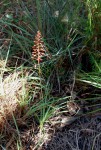
Photo: Stefaan Dondeyne
Along trail on eastern slope of Mt Magorogodo, Zomba, Chimanimani Conservation Area
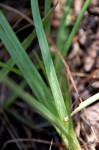
Photo: Stefaan Dondeyne
Along trail on eastern slope of Mt Magorogodo, Zomba, Chimanimani Conservation Area
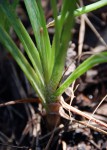
Photo: Stefaan Dondeyne
Along trail on eastern slope of Mt Magorogodo, Zomba, Chimanimani Conservation Area
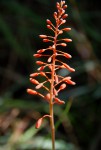
Photo: Stefaan Dondeyne
Along trail on eastern slope of Mt Magorogodo, Zomba, Chimanimani Conservation Area
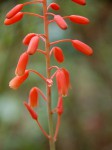
Photo: Stefaan Dondeyne
Along trail on eastern slope of Mt Magorogodo, Zomba, Chimanimani Conservation Area
Detailed records: Display species records QDS maps by: Google Maps Point records by Google Maps
Species details: Click on each item to see an explanation of that item (Note: opens a new window)
| Synonyms: | |
| Common names: | |
| Frequency: | Local and uncommon |
| Status: | Native |
| Description: |
Succulent perennial herb, suckering to forms small dense clusters. Stems clustered, erect, up to 3 cm high. Leaves weakly erect, grass-like, linear, up to 50 cm long, light green with whitish lines and spots, most densely on the lower surface near the base; margin with minute teeth 2-5 mm apart in the lower half. Inflorescence unbranched, up to 75 cm long, erect, with raceme 12-18 cm long, laxly flowered. Bracts c. 3 × 2 mm, ovate-acute, whitish, papery. Pedicels slender, 10-20 mm long. Flowers orange-scarlet, 12-16 mm long and c. 4 mm wide, cylindric, opening slightly towards the mouth. Capsule ovoid, up to c. 18 × 9 mm. |
| Notes: | - The plants are threatened by fires in dry years and is therefore listed as Vulnerable. - This variety is slightly more widespread than var. ballii and occurs at somewhat higher altitudes. It is easily distinguished by the erect habit and larger fruits. |
| Derivation of specific name: | ballii: named after J.S. Ball, who collected the type specimen; makurupiniensis: of the Makurupini River in the southern Chimanimani Mts |
| Habitat: | In open woodland among grasses on quartzite rock. |
| Altitude range: (metres) | 400 - 900 m |
| Flowering time: | Most of year |
| Worldwide distribution: | Lower slopes at the southern end of the Chimanimani Mountains in Zimbabwe and Mozambique. |
| Zimbabwe distribution: | E |
| Growth form(s): | |
| Endemic status: | Near Endemic |
| Red data list status: | Vulnerable |
| Insects associated with this species: | |
| Spot characters: | Display spot characters for this species |
| Images last updated: | Sunday 27 May 2012 |
| Literature: |
Carter, S. (2001). Aloaceae Flora Zambesiaca 12(3) Pages 57 - 58. Carter, S., Lavranos, J.J., Newton, L.E. & Walker, C.C. (2011). Aloes, The Definitive Guide Royal Botanic Gardens, Kew ISBN 978 1 84246439 7 Page 131. (Includes a picture). Darbyshire, I., Timberlake, J., Osborne, J., Rokni, S., Matimele, H., Langa. C., Datizua, C., de Sousa, C., Alves, T., Massingue, A., Hadj-Hammou, J., Dhanda, S., Shah, T., Wursten, B. (2019). The endemic plants of Mozambique: diversity and conservation status Phytotaxa 136 Page 76. Golding, J.S. (ed.) (2002). Zimbabwe Plant Red Data List. Southern African Plant Red Data Lists. SABONET 14 Page 161. Kimberley, M.J. (2003). Miniature Aloes in Zimbabwe Excelsa 20 Page 54. Mapaura, A. (2002). Endemic Plant Species of Zimbabwe. Kirkia 18(1) Page 125. Mapaura, A. & Timberlake, J. (eds) (2004). A checklist of Zimbabwean vascular plants Southern African Botanical Diversity Network Report No. 33 Sabonet, Pretoria and Harare Page 84. Timberlake, J., Darbyshire, I., Wursten, B., Hadj-Hammou, J., Ballings, P., Mapaura, A., Matimele, H., Banze, A., Chipanga, H., Muassinar, D., Massunde, J., Chelene, I., Osborne, J., Shah, T. (2016). Chimanimani Mountains: Botany and Conservation. Report produced under CEPF Grant 63512. Royal Botanic Gardens, Kew, London. Page 50. |
Other sources of information about Aloe ballii var. makurupiniensis:
Our websites:
Flora of Mozambique: Aloe ballii var. makurupiniensisExternal websites:
African Plants: A Photo Guide (Senckenberg): Aloe balliiAfrican Plant Database: Aloe ballii
BHL (Biodiversity Heritage Library): Aloe ballii
EOL (Encyclopedia of Life): Aloe ballii
GBIF (Global Biodiversity Information Facility): Aloe ballii
Google: Web - Images - Scholar
iNaturalist: Aloe ballii
IPNI (International Plant Names Index): Aloe ballii
JSTOR Plant Science: Aloe ballii
Mansfeld World Database of Agricultural and Horticultural Crops: Aloe ballii
Plants of the World Online: Aloe ballii
Tropicos: Aloe ballii
Wikipedia: Aloe ballii
| Home | > | List of families | > | Asphodelaceae | > | Aloe | > | ballii |