| Home | > | List of families | > | Smilacaceae | > | Smilax | > | anceps |
Smilax anceps
Selected images: Click on each image to see a larger version and details of the record View all images (17)
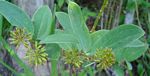
Photo: Bart Wursten
Ndundu Lodge, Vumba
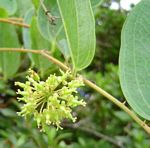
Photo: Bart Wursten
Ndundu Lodge, Vumba
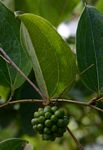
Photo: Bart Wursten
Tiger Kloof, Mutare
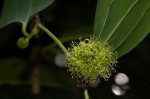
Photo: Bart Wursten
La Rochelle Botanic Garden, Penhalonga
Detailed records: Display species records QDS maps by: Google Maps Point records by Google Maps
Species details: Click on each item to see an explanation of that item (Note: opens a new window)
| Synonyms: |
Smilax kraussiana Meisn. Smilax mossambicensis Garcke |
| Common names: | Garuru (Shona) Gwananguruve (Shona) Smilax (English) Wild sarsaparilla (English) |
| Frequency: | Common in the Eastern Highlands, rare elsewhere |
| Status: | Native |
| Description: |
A vigorous scrambling vine. Stems up to 5 m long, tough, fibrous, armed with numerous hooked prickles and paired coiled tendrils at the base of the leaf petioles. Leaves alternate, ovate, elliptic to almost circular, 4-14 cm long, more or less thickly leathery, 2-3 pairs of veins along each side of the midrib and net-veining between these veins; margin entire; petiole 0.5-2.5 cm long, thickened, channeled above. Inflorescences many-flowered axillary globose umbels; peduncle up to 3 cm long with 2 ovate bracts near the middle, up to 5 mm long. Flowers unisexual in the same inflorescence; perianth segments 3-5 mm long, recurved, greenish-white, yellowish or brownish. Fruit a globose berry, 8-10 mm in diameter, purplish to black when ripe. |
| Notes: | Together with brambles (Rubus spp.) it often renders areas near-impenetrable and unpopular with hikers. The records in SRGH from outside Division E comprise a single vaguely localised record in Division N and three records from Division S, namely Old Bikita, Mt Buhwa and the Beza Range. |
| Derivation of specific name: | anceps: 2-edged or 2-headed |
| Habitat: | It is a typical constituent of the transitional ecotone between forest and grassland, where it can cover other vegetation. |
| Altitude range: (metres) | Up to 2400 m |
| Flowering time: | Aug - Jan |
| Worldwide distribution: | Widespread in tropical Africa, Eswatini, South Africa, Madagascar, Comores, Mauritius, Seychelles and Reunion. |
| Zimbabwe distribution: | N,E,S |
| Growth form(s): | Climber, shrub over 2 m. |
| Endemic status: | |
| Red data list status: | |
| Insects associated with this species: | Pseudoradiarctia scita (Larval food plant) Heliophisma klugii (Larval foodplant) Grammodes bifasciata (Larval foodplant) |
| Spot characters: | Display spot characters for this species |
| Images last updated: | Wednesday 18 March 2020 |
| Literature: |
Bandeira, S., Bolnick, D. & Barbosa, F. (2007). Wild Flowers of Southern Mozambique Universidade Eduardo Mondlane, Maputo, Mozambique Pages 64 - 65. (Includes a picture). Burrows, J.E. & Willis, C.K. (eds) (2005). Plants of the Nyika Plateau Southern African Botanical Diversity Network Report No. 31 SABONET, Pretoria Page 368. (Includes a picture). Chapano, C. & Mamuto, M. (2003). Plants of the Chimanimani District National Herbarium and Botanic Garden, Zimbabwe Page 51. Da Silva, M.C., Izidine, S. & Amude, A.B. (2004). A preliminary checklist of the vascular plants of Mozambique. Southern African Botanical Diversity Network Report No. 30 Sabonet, Pretoria Page 142. Diniz, M.A. (2009). Smilacaceae Flora Zambesiaca 12(2) Pages 198 - 200. (Includes a picture). Dowsett-Lemaire, F. (1989). The flora and phytogeography of the evergreen forests of Malawi. I: Afromontane and mid-altitude forests; Bull. Jard. Bot. Nat. Belg. 59(1/2) Page 24. As Smilax kraussiana Drummond, R.B. (1975). A list of trees, shrubs and woody climbers indigenous or naturalised in Rhodesia. Kirkia 10(1) Page 232. As Smilax kraussiana Mapaura, A. & Timberlake, J. (eds) (2004). A checklist of Zimbabwean vascular plants Southern African Botanical Diversity Network Report No. 33 Sabonet, Pretoria and Harare Page 112. Obermeyer, A.A. (1992). Smilacaceae Flora of Southern Africa 5(3) Page 85. (Includes a picture). Phiri, P.S.M. (2005). A Checklist of Zambian Vascular Plants Southern African Botanical Diversity Network Report No. 32 Page 137. Pooley, E. (1998). A Field Guide to the Wild Flowers of KwaZulu-Natal and the Eastern Region. Natal Flora Publications Trust. Durban. Pages 572 - 573. (Includes a picture). Steedman, E.C. (1933). Some Trees, Shrubs and Lianes of Southern Rhodesia. Pages 1 - 2. as Smilax kraussiana Timberlake, J.R., Bayliss, J., Dowsett-Lemaire, F., Congdon, C., Branch, B., Collins, S., Curran, M., Dowsett, R,J., Fishpool, L., Francisco, J., Harris, Kopp, M. & de Sousa, C. (2012). Mt Mabu, Mozambique: Biodiversity and Conservation Report produced under the Darwin Initiative Award 15/036. Royal Botanic Gardens, Kew, London Page 72. White, F. (1962). Forest Flora of Northern Rhodesia Oxford Univ. Press. Page 15. as Smilax kraussiana White, F., Dowsett-Lemaire, F. & Chapman, J.D. (2001). Evergreen forest flora of Malawi Royal Botanic Gardens, Kew Page 109. (Includes a picture). Wursten, B., Timberlake, J. & Darbyshire, I. (2017). The Chimanimani Mountains: an updated checklist. Kirkia 19(1) Page 86. |
Other sources of information about Smilax anceps:
Our websites:
Flora of Caprivi: cultivated Smilax ancepsFlora of Malawi: Smilax anceps
Flora of Mozambique: Smilax anceps
Flora of Zambia: Smilax anceps
External websites:
African Plants: A Photo Guide (Senckenberg): Smilax ancepsAfrican Plant Database: Smilax anceps
BHL (Biodiversity Heritage Library): Smilax anceps
EOL (Encyclopedia of Life): Smilax anceps
GBIF (Global Biodiversity Information Facility): Smilax anceps
Google: Web - Images - Scholar
iNaturalist: Smilax anceps
IPNI (International Plant Names Index): Smilax anceps
JSTOR Plant Science: Smilax anceps
Mansfeld World Database of Agricultural and Horticultural Crops: Smilax anceps
Plants of the World Online: Smilax anceps
Tropicos: Smilax anceps
Wikipedia: Smilax anceps
| Home | > | List of families | > | Smilacaceae | > | Smilax | > | anceps |