Acacia mearnsii
Selected images: Click on each image to see a larger version and details of the record View all images (6)
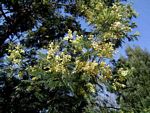
Photo: Bart Wursten
Misty Manor Hotel Site, Vumba
Detailed records: Display species records QDS maps by: Google Maps Point records by Google Maps
Species details: Click on each item to see an explanation of that item (Note: opens a new window)
| Synonyms: | |
| Common names: | Black wattle (English) |
| Frequency: | Locally abundant in the E Highlands |
| Status: | Introduced |
| Description: |
Unarmed shrub or small tree, to 15 m. Leaves: rhachis bearing glands on upper side, not only at the junction of each pair of pinnae but at other points as well. Leaves with c.12-20 pairs of pinnae; leaflets to 4 mm, numerous. Flowers pale yellow. Pods beaded, with 3-12 segments. |
| Type location: |
|
| Notes: | A very fast growing species, flowering and producing large amounts of seeds within a year. The germination of the seeds is stimulated by fires. It is very similar to A. dealbata, another Australian invader, which lacks the glands between the top pairs of pinnae. The leaves of A. dealbata are grey-green, giving the trees a much lighter appearance than A. mearnsii. When in flower, the two species are more easily separated as the flowers of A. dealbata are bright yellow, while those of A. mearnsii are very pale yellow or cream. Also see A. melanoxylon for comparison. |
| Derivation of specific name: | |
| Habitat: | An aggressive invader of grasslands and forest margins in high rainfall areas of Tropical and Southern Africa. |
| Altitude range: (metres) | Above 1200 m |
| Flowering time: | Sep |
| Worldwide distribution: | Native of Australia; naturalised in southern Africa. |
| FZ divisions: | E |
| Growth form(s): | Tree. |
| Endemic status: | |
| Red data list status: | |
| Insects associated with this species: | Chiasmia simplicilinea (Food plant) Ericeia inangulata (Larval food plant) Pseudoradiarctia scita (Larval food plant) Achaea catella (Larval food plant) Heniocha apollonia (Larval foodplant) Gynanisa maja (Larval foodplant) Catalebeda cuneilinea (Larval foodplant) |
| Spot characters: | Display spot characters for this species |
| Images last updated: | Monday 17 October 2005 |
| Literature: |
Biegel, H.M. (1977). Check-list of ornamental plants used in Rhodesian parks and gardens. Rhodesia Agricultural Journal. Research Report No. 3. Page 17. Brenan, J.P.M. (1970). Mimosoideae Flora Zambesiaca 3(1) Pages 111 - 112. Burrows, J.E., Burrows, S.M., Lötter, M.C. & Schmidt, E. (2018). Trees and Shrubs Mozambique Publishing Print Matters (Pty), Cape Town. Page 210. (Includes a picture). Chapano, C. & Mamuto, M. (2003). Plants of the Chimanimani District National Herbarium and Botanic Garden, Zimbabwe Page 2. Da Silva, M.C., Izidine, S. & Amude, A.B. (2004). A preliminary checklist of the vascular plants of Mozambique. Southern African Botanical Diversity Network Report No. 30 Sabonet, Pretoria Page 151. Drummond, R.B. (1972). A list of Rhodesian Legumes. Kirkia 8(2) Page 214. Drummond, R.B. (1975). A list of trees, shrubs and woody climbers indigenous or naturalised in Rhodesia. Kirkia 10(1) Page 241. Fischer, E. & Killmann, D. (2008). Illustrated Field guide to the Plants of Nyungwe National Park Rwanda. University of Koblenz-Landau. Pages 156 - 157. Henderson, L. (2001). Alien weeds and invasive plants Plant Protection Research Institute Handbook No. 12. Plant Protection Research Institute, Agricultural Research Council, South Africa. Page 222. (Includes a picture). Mapaura, A. & Timberlake, J. (eds) (2004). A checklist of Zimbabwean vascular plants Southern African Botanical Diversity Network Report No. 33 Sabonet, Pretoria and Harare Page 44. Ntore, S. & al. (2024). Checklist of the vascular plants of Burundi Page 111. Schmidt, E., Lötter, M. & McCleland, W. (2002). Trees and shrubs of Mpumalanga and Kruger National Park Jacana, Johannesburg, South Africa Pages 156 - 157. (Includes a picture). Timberlake, J., Fagg, C. & Barnes, R. (1999). Field Guide to the Acacias of Zimbabwe CBC Publishing, Harare Pages 140 - 141. (Includes a picture). Troupin, G. (1978). Mimosaceae Flore du Rwanda Spermatophytes Volume I Pages 365 - 370. (Includes a picture). |
Other sources of information about Acacia mearnsii:
Our websites:
Flora of Burundi: Acacia mearnsiiFlora of Malawi: Acacia mearnsii
Flora of Malawi: cultivated Acacia mearnsii
Flora of Mozambique: Acacia mearnsii
Flora of Mozambique: cultivated Acacia mearnsii
Flora of Rwanda: Acacia mearnsii
Flora of Rwanda: cultivated Acacia mearnsii
Flora of Zimbabwe: cultivated Acacia mearnsii
External websites:
African Plants: A Photo Guide (Senckenberg): Acacia mearnsiiAfrican Plant Database: Acacia mearnsii
BHL (Biodiversity Heritage Library): Acacia mearnsii
EOL (Encyclopedia of Life): Acacia mearnsii
GBIF (Global Biodiversity Information Facility): Acacia mearnsii
Google: Web - Images - Scholar
iNaturalist: Acacia mearnsii
IPNI (International Plant Names Index): Acacia mearnsii
JSTOR Plant Science: Acacia mearnsii
Mansfeld World Database of Agricultural and Horticultural Crops: Acacia mearnsii
Plants of the World Online: Acacia mearnsii
Tropicos: Acacia mearnsii
Wikipedia: Acacia mearnsii