Croton sylvaticus
Selected images: Click on each image to see a larger version and details of the record View all images (20)
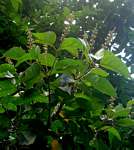
Photo: Bart Wursten
Vumba rd in Bunga Forest
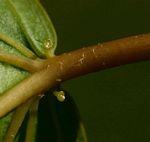
Photo: Bart Wursten
Ndundu Lodge, Vumba
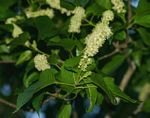
Photo: Bart Wursten
Vumba Rd at corner of Jevington rd, Vumba
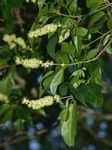
Photo: Bart Wursten
Vumba Rd at corner of Jevington rd, Vumba
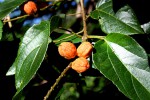
Photo: Mark Hyde
48, Borrowdale Road, Harare
Detailed records: Display species records QDS maps by: Google Maps Point records by Google Maps
Species details: Click on each item to see an explanation of that item (Note: opens a new window)
| Synonyms: |
Croton bukobensis Pax Croton oxypetalus Müll. Arg. Croton stuhlmannii Pax Croton verdickii De Wild. |
| Common names: | Forest croton (English) Mount Selinda linden (English) Mubvukuta (Shona) Murungamunu (Shona) Musuguta (Shona) |
| Frequency: | Locally common |
| Status: | Native |
| Description: |
Shrub or medium to large deciduous tree. Bark pale to dark grey, smooth when young, slightly rough in older trees. Leaves elliptic, ovate or ovate-lanceolate, up to c. 20 cm long, fairly thinly textured, somewhat almond-like aromatic when crushed, stellate hairy on both surfaces when young, hairless when older, 3-5-veined from the base, stalked glands present at the base of the leaf below; margin with glandular teeth. Flowers in terminal racemes, unisexual, mostly male with some female flowers near the base of the inflorescence. Fruit 3-lobed, up to 1 cm in diameter, in conspicuous clusters, orange when ripe. |
| Type location: |
South Africa, KwaZulu-Natal |
| Notes: | This species could be confused with Macaranga mellifera and M. capensis, trees growing in similar habitats. However, in both these species the leaves are densely covered in small golden glands on the under surface but lack stellate hairs and the stalked glands at the base of the leaf below. C. sylvaticus has stellate hairs below, particularly when young and small stalked glands at the base below (image 2) but no golden glands. |
| Derivation of specific name: | sylvaticus: sylvan, forest-loving |
| Habitat: | In forest or associated dense woodland, sometimes as a pioneer species. |
| Altitude range: (metres) | Up to 1700 m |
| Flowering time: | Oct - Dec |
| Worldwide distribution: | Widespread throughout most of tropical Africa |
| FZ divisions: | E,S |
| Growth form(s): | Tree. |
| Endemic status: | |
| Red data list status: | |
| Insects associated with this species: | Epiphora mythimnia (Larval foodplant) |
| Spot characters: | Display spot characters for this species |
| Images last updated: | Tuesday 30 April 2013 |
| Literature: |
Burrows, J.E., Burrows, S.M., Lötter, M.C. & Schmidt, E. (2018). Trees and Shrubs Mozambique Publishing Print Matters (Pty), Cape Town. Page 444. (Includes a picture). Dowsett-Lemaire, F. (1989). The flora and phytogeography of the evergreen forests of Malawi. I: Afromontane and mid-altitude forests; Bull. Jard. Bot. Nat. Belg. 59(1/2) Page 18. Drummond, R.B. (1975). A list of trees, shrubs and woody climbers indigenous or naturalised in Rhodesia. Kirkia 10(1) Page 252. Mapaura, A. & Timberlake, J. (eds) (2004). A checklist of Zimbabwean vascular plants Southern African Botanical Diversity Network Report No. 33 Sabonet, Pretoria and Harare Page 41. Ntore, S. & al. (2024). Checklist of the vascular plants of Burundi Page 108. Radcliffe-Smith, A. (1996). Euphorbiaceae Flora Zambesiaca 9(4) Pages 286 - 287. Siebert, S. & Mössmer, M. (Editors) (2002). SABONET Southern Mozambique Expedition 2001; Provisional Plant Checklist of the Maputo Elephant Reserve (MER) and Licuati Forest Reserve (LFR) SABONET News 7(1) Page 25. Steedman, E.C. (1933). Some Trees, Shrubs and Lianes of Southern Rhodesia. Page 36. Strugnell, A.M. (2006). A Checklist of the Spermatophytes of Mount Mulanje, Malawi Scripta Botanica Belgica 34 National Botanic Garden of Belgium Page 86. Timberlake, J.R., Bayliss, J., Dowsett-Lemaire, F., Congdon, C., Branch, B., Collins, S., Curran, M., Dowsett, R,J., Fishpool, L., Francisco, J., Harris, Kopp, M. & de Sousa, C. (2012). Mt Mabu, Mozambique: Biodiversity and Conservation Report produced under the Darwin Initiative Award 15/036. Royal Botanic Gardens, Kew, London Page 73. |
Other sources of information about Croton sylvaticus:
Our websites:
Flora of Burundi: Croton sylvaticusFlora of Malawi: Croton sylvaticus
Flora of Mozambique: Croton sylvaticus
Flora of Zambia: Croton sylvaticus
Flora of Zimbabwe: cultivated Croton sylvaticus
External websites:
African Plants: A Photo Guide (Senckenberg): Croton sylvaticusAfrican Plant Database: Croton sylvaticus
BHL (Biodiversity Heritage Library): Croton sylvaticus
EOL (Encyclopedia of Life): Croton sylvaticus
GBIF (Global Biodiversity Information Facility): Croton sylvaticus
Google: Web - Images - Scholar
iNaturalist: Croton sylvaticus
IPNI (International Plant Names Index): Croton sylvaticus
JSTOR Plant Science: Croton sylvaticus
Mansfeld World Database of Agricultural and Horticultural Crops: Croton sylvaticus
Plants of the World Online: Croton sylvaticus
Tropicos: Croton sylvaticus
Wikipedia: Croton sylvaticus