Combretum microphyllum
Selected images: Click on each image to see a larger version and details of the record View all images (21)
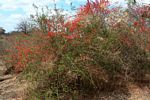
Photo: Petra Ballings
Rd nr Chisumbanje, Save Valley
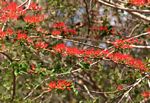
Photo: Petra Ballings
Rd nr Chisumbanje, Save Valley
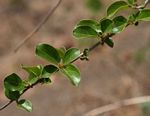
Photo: Petra Ballings
Rd nr Chisumbanje, Save Valley
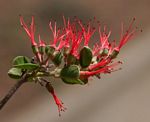
Photo: Petra Ballings
Rd nr Chisumbanje, Save Valley
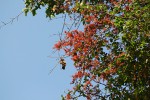
Photo: Mark Hyde
By Mazowe River, Hippo Pools
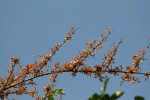
Photo: Mark Hyde
By Mazowe River, Hippo Pools
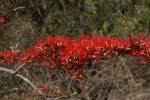
Photo: Mark Hyde
Mahenye Village
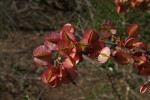
Photo: Mark Hyde
Mahenye Village
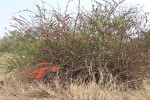
Photo: Mark Hyde
Hillside Park, Harare
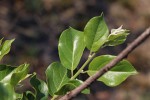
Photo: Mark Hyde
Hillside Park, Harare
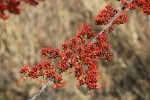
Photo: Mark Hyde
Hillside Park, Harare
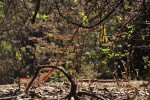
Photo: Mark Hyde
Mukuvisi Woodland close encounter zone
Detailed records: Display species records QDS maps by: Google Maps Point records by Google Maps
Species details: Click on each item to see an explanation of that item (Note: opens a new window)
| Synonyms: |
Combretum paniculatum Vent. subsp. microphyllum (Klotzsch) Wickens |
| Common names: | Bambangwenya (Hlengwe) Burning-bush combretum (English) Ganwa-musero (Shona) Mupfurura (Shona) Mutsiwa (Shona) Mutzutsu (Shona) Riverine flame-creeper (English) |
| Frequency: | Occasional |
| Status: | Native |
| Description: |
Large woody creeper. The persistent bases of the petioles modify into woody spines. Leaves opposite or 3-whorled, ovate, oblong-elliptic to sub-circular, glossy dark green above, dull below, venation distinctly yellowish, both sides with or without hairs, apex rounded with a small point; petiole up to 3 cm. Flowers bright red, produced in profusion along the trailing branches, appearing before the new leaves. Fruit c. 25 mm in diameter, 4-winged, light green to pinkish when young, drying to light brown. |
| Type location: |
Mozambique |
| Notes: | Note: It is similar to C. paniculatum and is sometimes regarded as a subspecies. It differs in its preference for dry and hot, low altitude riverbanks, while C. paniculatum is an uncommon species of moist evergreen forest margins. C. microphyllum normally flowers before the leaves appear. |
| Derivation of specific name: | microphyllum: small-leaved |
| Habitat: | In riverine scrub, where it often covers trees and bushes. |
| Altitude range: (metres) | |
| Flowering time: | Jul - Nov |
| Worldwide distribution: | Widespread in Tropical Africa to Mpumalanga and KwaZulu-Natal, South Africa |
| FZ divisions: | N,W,C,E,S |
| Growth form(s): | |
| Endemic status: | |
| Red data list status: | |
| Insects associated with this species: | |
| Spot characters: | Display spot characters for this species |
| Images last updated: | Tuesday 8 June 2010 |
| Literature: |
Burrows, J.E., Burrows, S.M., Lötter, M.C. & Schmidt, E. (2018). Trees and Shrubs Mozambique Publishing Print Matters (Pty), Cape Town. Page 680. (Includes a picture). Chapano, C. & Mamuto, M. (2003). Plants of the Chimanimani District National Herbarium and Botanic Garden, Zimbabwe Page 15. Chapano, C. & Mugarisanwa, N.H. (2003). Plants of the Matobo District National Herbarium and Botanic Garden, Zimbabwe Page 9. Coates Palgrave, K. (revised and updated by Meg Coates Palgrave) (2002). Trees of Southern Africa 3rd edition. Struik, South Africa Pages 804 - 805. (Includes a picture). Da Silva, M.C., Izidine, S. & Amude, A.B. (2004). A preliminary checklist of the vascular plants of Mozambique. Southern African Botanical Diversity Network Report No. 30 Sabonet, Pretoria Page 46. Drummond, R.B. (1975). A list of trees, shrubs and woody climbers indigenous or naturalised in Rhodesia. Kirkia 10(1) Page 263. As Combretum paniculatum microphyllum Exell, A.W. (1978). Combretaceae Flora Zambesiaca 4 Pages 150 - 151. Mapaura, A. & Timberlake, J. (eds) (2004). A checklist of Zimbabwean vascular plants Southern African Botanical Diversity Network Report No. 33 Sabonet, Pretoria and Harare Page 35. Phiri, P.S.M. (2005). A Checklist of Zambian Vascular Plants Southern African Botanical Diversity Network Report No. 32 Page 41. Plowes, D.C.H. & Drummond, R.B. (1990). Wild Flowers of Zimbabwe. Revised edition. Longman, Zimbabwe. No. 84, plates 114 & 115 Schmidt, E., Lötter, M. & McCleland, W. (2002). Trees and shrubs of Mpumalanga and Kruger National Park Jacana, Johannesburg, South Africa Pages 464 - 465. (Includes a picture). Setshogo, M.P. (2005). Preliminary checklist of the plants of Botswana. Sabonet Report no. 37. Sabonet, Pretoria and Gaborone Page 47. |
Other sources of information about Combretum microphyllum:
Our websites:
Flora of Botswana: Combretum microphyllumFlora of Malawi: Combretum microphyllum
Flora of Mozambique: Combretum microphyllum
Flora of Zambia: Combretum microphyllum
Flora of Zimbabwe: cultivated Combretum microphyllum
External websites:
African Plants: A Photo Guide (Senckenberg): Combretum microphyllumAfrican Plant Database: Combretum microphyllum
BHL (Biodiversity Heritage Library): Combretum microphyllum
EOL (Encyclopedia of Life): Combretum microphyllum
GBIF (Global Biodiversity Information Facility): Combretum microphyllum
Google: Web - Images - Scholar
iNaturalist: Combretum microphyllum
IPNI (International Plant Names Index): Combretum microphyllum
JSTOR Plant Science: Combretum microphyllum
Mansfeld World Database of Agricultural and Horticultural Crops: Combretum microphyllum
Plants of the World Online: Combretum microphyllum
Tropicos: Combretum microphyllum
Wikipedia: Combretum microphyllum