| Home | > | List of families | > | Melastomataceae | > | Dissotis | > | swynnertonii |
Dissotis swynnertonii
Selected images: Click on each image to see a larger version and details of the record View all images (15)
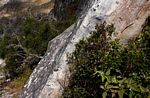
Photo: Bart Wursten
Path to Mt Pheza, Chimanimani National Park, Mozambique
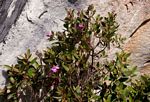
Photo: Bart Wursten
Path to Mt Pheza, Chimanimani National Park, Mozambique
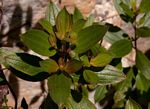
Photo: Bart Wursten
Path to Mt Pheza, Chimanimani National Park, Mozambique
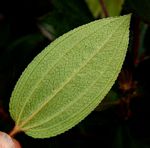
Photo: Bart Wursten
Path to Mt Pheza, Chimanimani National Park, Mozambique
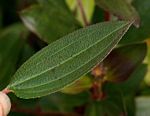
Photo: Bart Wursten
Path to Mt Pheza, Chimanimani National Park, Mozambique
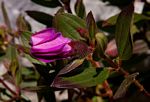
Photo: Bart Wursten
Path to Mt Pheza, Chimanimani National Park, Mozambique
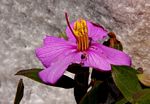
Photo: Bart Wursten
Path to Mt Pheza, Chimanimani National Park, Mozambique
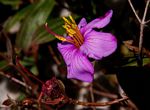
Photo: Bart Wursten
Path to Mt Pheza, Chimanimani National Park, Mozambique
Detailed records: Display species records QDS maps by: Google Maps Point records by Google Maps
Species details: Click on each item to see an explanation of that item (Note: opens a new window)
| Synonyms: |
Osbeckia swynnertonii Baker f. Pseudosbeckia swynnertonii (Baker f.) A. & R. Fern. |
| Common names: | |
| Frequency: | Locally frequent |
| Status: | Native |
| Description: |
Shrub up to c. 2 m high. Young branches 4-angled, more or less densely set with whitish-yellow bristly hairs. Leaves opposite often mostly towards the ends of branches, elliptic, oblong-ovate to ovate, up to c. 5 × 2.5 cm, 3-5-veined from the base, somewhat stiff, discolorous, dark green and with appressed bristly hairs above, much paler yellowish-green beneath and bristly particularly on the midrib and veins; margin subentire to finely scalloped; petiole 4-8 mm long, bristly. Flowers terminal, solitary or in few-flowered heads; pedicels and calyx bristly. Petals up to 3 × 2.7 cm, violet-purple, ciliate at the margin. stamens all similar, golden yellow. Capsule spherical, with stiff appressed hairs on the upper part. |
| Notes: | Although the species is nowadays considered as part of Dissotis again, it is clearly distinguished from other Dissotis spp. by the uniform stamens. |
| Derivation of specific name: | swynnertonii: named after Charles Francis Massey Swynnerton (1877-1938), well-known naturalist, who first recorded and collected many species of flora and fauna in and around the Chirinda Forest |
| Habitat: | On rocky slopes, in Brachystegia woodland and along streams and rivers. |
| Altitude range: (metres) | |
| Flowering time: | |
| Worldwide distribution: | Restricted to the Chimanimani Mts of Zimbabwe and Mozambique. |
| Zimbabwe distribution: | E |
| Growth form(s): | |
| Endemic status: | Near Endemic |
| Red data list status: | Lower Risk - near threatened |
| Insects associated with this species: | |
| Spot characters: | Display spot characters for this species |
| Images last updated: | Saturday 3 September 2011 |
| Literature: |
Burrows, J.E., Burrows, S.M., Lötter, M.C. & Schmidt, E. (2018). Trees and Shrubs Mozambique Publishing Print Matters (Pty), Cape Town. Page 707. (Includes a picture). Chapano, C. & Mamuto, M. (2003). Plants of the Chimanimani District National Herbarium and Botanic Garden, Zimbabwe Page 46. As Pseudosbeckia swynnertonii Darbyshire, I., Timberlake, J., Osborne, J., Rokni, S., Matimele, H., Langa. C., Datizua, C., de Sousa, C., Alves, T., Massingue, A., Hadj-Hammou, J., Dhanda, S., Shah, T., Wursten, B. (2019). The endemic plants of Mozambique: diversity and conservation status Phytotaxa 136 Page 90. Fernandes, R. & A. (1978). Melastomataceae Flora Zambesiaca 4 Pages 234 - 235. As Pseudosbeckia swynnertonii (Includes a picture). Golding, J.S. (ed.) (2002). Zimbabwe Plant Red Data List. Southern African Plant Red Data Lists. SABONET 14 Page 175. As Pseudosbeckia swynnertonii Mapaura, A. & Timberlake, J. (eds) (2004). A checklist of Zimbabwean vascular plants Southern African Botanical Diversity Network Report No. 33 Sabonet, Pretoria and Harare Page 61. Wild, H. (1964). The endemic species of the Chimanimani Mountains and their significance Kirkia 4 Pages 144 - 145. as Pseudosbeckia swynnertonii Wursten, B., Timberlake, J. & Darbyshire, I. (2017). The Chimanimani Mountains: an updated checklist. Kirkia 19(1) Page 95. |
Other sources of information about Dissotis swynnertonii:
Our websites:
Flora of Mozambique: Dissotis swynnertoniiExternal websites:
African Plants: A Photo Guide (Senckenberg): Dissotis swynnertoniiBHL (Biodiversity Heritage Library): Dissotis swynnertonii
EOL (Encyclopedia of Life): Dissotis swynnertonii
GBIF (Global Biodiversity Information Facility): Dissotis swynnertonii
Google: Web - Images - Scholar
iNaturalist: Dissotis swynnertonii
IPNI (International Plant Names Index): Dissotis swynnertonii
JSTOR Plant Science: Dissotis swynnertonii
Mansfeld World Database of Agricultural and Horticultural Crops: Dissotis swynnertonii
Plants of the World Online: Dissotis swynnertonii
Tropicos: Dissotis swynnertonii
Wikipedia: Dissotis swynnertonii
| Home | > | List of families | > | Melastomataceae | > | Dissotis | > | swynnertonii |