Agelanthus subulatus
Selected images: Click on each image to see a larger version and details of the record View all images (11)
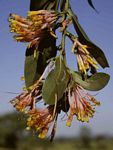
Photo: Darrel Plowes
South of Ngundu Halt, 100 km South of Masvingo
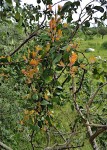
Photo: Ian Riddell
Mukuvisi Woodland, Harare.
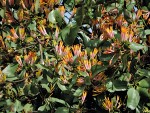
Photo: Ian Riddell
Mukuvisi Woodland, Harare.
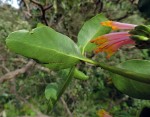
Photo: Ian Riddell
Mukuvisi Woodland, Harare.
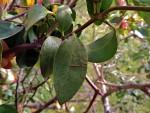
Photo: Ian Riddell
Mukuvisi Woodland, Harare.
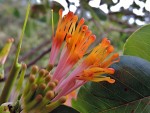
Photo: Ian Riddell
Mukuvisi Woodland, Harare.
Detailed records: Display species records QDS maps by: Google Maps Point records by Google Maps
Species details: Click on each item to see an explanation of that item (Note: opens a new window)
| Synonyms: |
Loranthus subulatus Engl. Tapinanthus subulatus (Engl.) Danser, |
| Common names: | |
| Frequency: | |
| Status: | Native |
| Description: |
Parasitic shrub with spreading stems and short lateral branches. Branchlets terete or 4-angled to slightly winged, most parts glabrous. Leaves opposite or subopposite, somewhat leathery, dull to dark green or sometimes slightly blue-green, lanceolate to ovate-elliptic with 6–12 pairs of lateral nerves. Flowers in solitary umbels, axillary or terminal. Corolla 3.5–5 cm long, white at base, then pink or orange, banded green-yellow just below vents, yellow or yellow and red over vents, with green tip; lobes erect, 8–12 mm long. Stamen filaments red below, yellow or green above. Style green above, slender. Berry red, oblong-ellipsoid; seed bright yellow. |
| Type location: |
Tanzania |
| Notes: | An attractive and easily recognised species, mostly found on legumes, particularly Pterocarpus angolensis and P. rotundifolius subsp. rotundifolius, but also on Combretum and other families, including cultivated trees. |
| Derivation of specific name: | subulatus: flat and narrow, tapering from the base to a sharp tip, subulate |
| Habitat: | Along forest margins, in woodland and wooded grassland, often in transitional zones. |
| Altitude range: (metres) | Up to 1650 m |
| Flowering time: | Nov - Mar |
| Worldwide distribution: | From Somalia to Zimbabwe and Mozambique |
| FZ divisions: | N,C,E,S |
| Growth form(s): | |
| Endemic status: | |
| Red data list status: | |
| Insects associated with this species: | |
| Spot characters: | Display spot characters for this species |
| Images last updated: | Friday 6 March 2026 |
| Literature: |
Burrows, J.E. & Willis, C.K. (eds) (2005). Plants of the Nyika Plateau Southern African Botanical Diversity Network Report No. 31 SABONET, Pretoria Page 200. Chapano, C. & Mamuto, M. (2003). Plants of the Chimanimani District National Herbarium and Botanic Garden, Zimbabwe Page 3. As Agelantha subulatus Mapaura, A. & Timberlake, J. (eds) (2004). A checklist of Zimbabwean vascular plants Southern African Botanical Diversity Network Report No. 33 Sabonet, Pretoria and Harare Page 59. Polhill, R.M. & Wiens, D. (2006). Loranthaceae Flora Zambesiaca 9(3) Page 148. |
Other sources of information about Agelanthus subulatus:
Our websites:
Flora of Malawi: Agelanthus subulatusFlora of Mozambique: Agelanthus subulatus
Flora of Zambia: Agelanthus subulatus
External websites:
African Plants: A Photo Guide (Senckenberg): Agelanthus subulatusAfrican Plant Database: Agelanthus subulatus
BHL (Biodiversity Heritage Library): Agelanthus subulatus
EOL (Encyclopedia of Life): Agelanthus subulatus
GBIF (Global Biodiversity Information Facility): Agelanthus subulatus
Google: Web - Images - Scholar
iNaturalist: Agelanthus subulatus
IPNI (International Plant Names Index): Agelanthus subulatus
JSTOR Plant Science: Agelanthus subulatus
Mansfeld World Database of Agricultural and Horticultural Crops: Agelanthus subulatus
Plants of the World Online: Agelanthus subulatus
Tropicos: Agelanthus subulatus
Wikipedia: Agelanthus subulatus