Vinca major
Selected images: Click on each image to see a larger version and details of the record View all images (3)
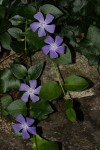
Photo: Bart Wursten
Pine Tree Inn, Juliasdale
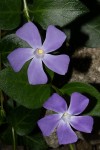
Photo: Bart Wursten
Pine Tree Inn, Juliasdale
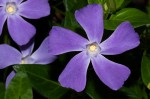
Photo: Bart Wursten
Pine Tree Inn, Juliasdale
Detailed records: Display species records QDS maps by: Google Maps Point records by Google Maps
Species details: Click on each item to see an explanation of that item (Note: opens a new window)
| Synonyms: | |
| Common names: | Bigleaf periwinkle (English) Blue periwinkle (English) Greater periwinkle (English) Large periwinkle (English) |
| Frequency: | |
| Status: | Introduced, cultivated and a rare escape |
| Description: |
Evergreen, prostrate, creeping perennial herb, often forming large ground covering patches. Stems up to 5 m long, rooting at the nodes. Leaves opposite, very broadly elliptic-ovate, 3-9 cm long; narrower lanceolate and shorter near the ends of the branches, glossy dark green and leathery; margin entire but ciliate with a fringe of hairs; petiole 1-2 cm long. Flowers solitary, axillary. corolla 5-lobed, mauve-blue to purple, 3-5 cm in diameter. |
| Type location: |
|
| Notes: | Similar to Vinca minor. That species is generally smaller in all aspects including flowers and is completely hairless. Leaves of V. major are broader with a fringe of hairs around the margin. |
| Derivation of specific name: | major: the larger. |
| Habitat: | Planted in gardens, particularly as a ground cover in flower beds. |
| Altitude range: (metres) | |
| Flowering time: | |
| Worldwide distribution: | Native to the western Mediterranean. |
| FZ divisions: | C,E |
| Growth form(s): | |
| Endemic status: | |
| Red data list status: | |
| Insects associated with this species: | |
| Spot characters: | Display spot characters for this species |
| Images last updated: | Monday 14 January 2019 |
| Literature: |
Other sources of information about Vinca major:
Our websites:
Flora of Zimbabwe: cultivated Vinca majorExternal websites:
African Plants: A Photo Guide (Senckenberg): Vinca majorAfrican Plant Database: Vinca major
BHL (Biodiversity Heritage Library): Vinca major
EOL (Encyclopedia of Life): Vinca major
GBIF (Global Biodiversity Information Facility): Vinca major
Google: Web - Images - Scholar
iNaturalist: Vinca major
IPNI (International Plant Names Index): Vinca major
JSTOR Plant Science: Vinca major
Mansfeld World Database of Agricultural and Horticultural Crops: Vinca major
Plants of the World Online: Vinca major
Tropicos: Vinca major
Wikipedia: Vinca major