Ficus sur
Selected images: Click on each image to see a larger version and details of the record View all images (20)
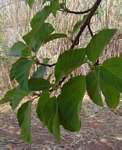
Photo: Bart Wursten
Mukuvisi Woodland, office area
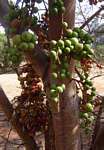
Photo: Bart Wursten
Mukuvisi Woodland, office area
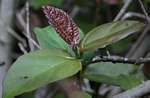
Photo: Bart Wursten
Nyamaropa Falls, Wattle Co Estate
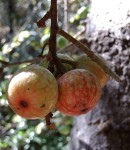
Photo: Rob Burrett
Along path to Nanke Cave, Matopos.
Detailed records: Display species records QDS maps by: Google Maps Point records by Google Maps
Species details: Click on each item to see an explanation of that item (Note: opens a new window)
| Synonyms: |
Ficus capensis Thunb. Ficus mallotocarpa Warb. |
| Common names: | Broom-cluster fig (English) Cape fig (English) |
| Frequency: | Common |
| Status: | Native |
| Description: |
Large spreading tree. All parts exude a milky latex. Main stem may be buttressed in large forest specimens; bark pale grey, smooth. Leaves alternate, spiralled, ovate to elliptic, thinly leathery; margin crenate-dentate. The upper surface normally glabrous, the undersurface variously pubescent. Figs in large clusters, borne on leafless branchlets, growing from the main stem and older branches. Figs vary from glabrous to puberulent to densely tomentose, bright green, turning orange to red when ripe. |
| Type location: |
Yemen |
| Notes: | The fruits are edible but often riddled with small insects. The latex is used to treat burns. |
| Derivation of specific name: | sur: probably from the Arabic name for this species in the Arabian peninsula, where it was first collected. |
| Habitat: | In open woodland, riverine and semi deciduous forest and on rocky hillsides. |
| Altitude range: (metres) | Up to 2300 m |
| Flowering time: | Sep - Mar |
| Worldwide distribution: | Tropical and southern Africa, also the Arabian peninsula. |
| FZ divisions: | N,W,C,E,S |
| Growth form(s): | Tree. |
| Endemic status: | |
| Red data list status: | |
| Insects associated with this species: | Cyrestis camillus sublineata (Food plant) Nephele accentifera (Food plant) Ceratosolen capensis (Pollinated by this insect) Asota speciosa (Larval foodplant) |
| Spot characters: | Display spot characters for this species |
| Images last updated: | Sunday 11 October 2020 |
| Literature: |
Berg, C.C. (1991). Moraceae Flora Zambesiaca 9(6) Pages 52 - 53. Burrows, J.E. & Burrows, S.M. (2003). Figs of Southern and South-Central Africa Umdaus Press, South Africa Pages 67 - 71. (Includes a picture). Burrows, J.E. & Willis, C.K. (eds) (2005). Plants of the Nyika Plateau Southern African Botanical Diversity Network Report No. 31 SABONET, Pretoria Page 215. Burrows, J.E., Burrows, S.M., Lötter, M.C. & Schmidt, E. (2018). Trees and Shrubs Mozambique Publishing Print Matters (Pty), Cape Town. Page 76. (Includes a picture). Chapano, C. & Mamuto, M. (2003). Plants of the Chimanimani District National Herbarium and Botanic Garden, Zimbabwe Page 27. Chapano, C. & Mugarisanwa, N.H. (2003). Plants of the Matobo District National Herbarium and Botanic Garden, Zimbabwe Page 17. Coates Palgrave, K. (revised and updated by Meg Coates Palgrave) (2002). Trees of Southern Africa 3rd edition. Struik, South Africa Pages 149 - 150. (Includes a picture). Coates Palgrave, K. et al. (1956). Trees of Central Africa National Publications Trust, Salisbury. Pages 276 - 279. as Ficus capensis (Includes a picture). Coates Palgrave, M. (1989). Guide to the trees and shrubs of the Mukuvisi Woodlands ?publisher. Page 15. Dowsett-Lemaire, F. (1989). The flora and phytogeography of the evergreen forests of Malawi. I: Afromontane and mid-altitude forests; Bull. Jard. Bot. Nat. Belg. 59(1/2) Page 18. As Ficus capensis Drummond, R.B. (1975). A list of trees, shrubs and woody climbers indigenous or naturalised in Rhodesia. Kirkia 10(1) Page 234. As Ficus capensis Drummond, R.B. (1981). Common Trees of the Central Watershed Woodlands of Zimbabwe. Natural Resources Board, Harare. Pages 16 - 17. as Ficus capensis (Includes a picture). Figueiredo, E. & Smith, G.F. (2008). Plants of Angola Strelitzia 22 SANBI, Pretoria Page 122. Mapaura, A. & Timberlake, J. (eds) (2004). A checklist of Zimbabwean vascular plants Southern African Botanical Diversity Network Report No. 33 Sabonet, Pretoria and Harare Page 63. Meerts, P. & Hasson, M. (2016). Arbres et arbustes du Haut-Katanga Jardin Botanique Meise, Belgique Page 114. (Includes a picture). Ntore, S. & al. (2024). Checklist of the vascular plants of Burundi Page 166. Setshogo, M.P. (2005). Preliminary checklist of the plants of Botswana. Sabonet Report no. 37. Sabonet, Pretoria and Gaborone Page 88. Steedman, E.C. (1933). Some Trees, Shrubs and Lianes of Southern Rhodesia. Page 4. as Ficus capensis (Includes a picture). Troupin, G. (1978). Moraceae Flore du Rwanda Spermatophytes Volume I Pages 142 - 145. as F. capensis and F. mallotocarpa (Includes a picture). |
Other sources of information about Ficus sur:
Our websites:
Flora of Angola: Ficus surFlora of Botswana: Ficus sur
Flora of Burundi: Ficus sur
Flora of the DRC: Ficus sur
Flora of Kenya: Ficus sur
Flora of Malawi: Ficus sur
Flora of Mozambique: Ficus sur
Flora of Rwanda: Ficus sur
Flora of Tanzania: Ficus sur
Flora of Uganda: Ficus sur
Flora of Zambia: Ficus sur
Flora of Zimbabwe: cultivated Ficus sur
External websites:
African Plants: A Photo Guide (Senckenberg): Ficus surAfrican Plant Database: Ficus sur
BHL (Biodiversity Heritage Library): Ficus sur
EOL (Encyclopedia of Life): Ficus sur
GBIF (Global Biodiversity Information Facility): Ficus sur
Google: Web - Images - Scholar
iNaturalist: Ficus sur
IPNI (International Plant Names Index): Ficus sur
JSTOR Plant Science: Ficus sur
Mansfeld World Database of Agricultural and Horticultural Crops: Ficus sur
Plants of the World Online: Ficus sur
Tropicos: Ficus sur
Wikipedia: Ficus sur