Euphorbia tirucalli
Selected images: Click on each image to see a larger version and details of the record View all images (15)
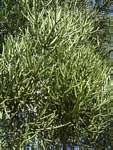
Photo: Bart Wursten
Rd to Domboshawa, Chinamora CL
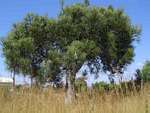
Photo: Bart Wursten
Rd to Domboshawa, Chinamora CL
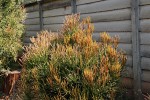
Photo: Mark Hyde
Blue Kerry, Harare
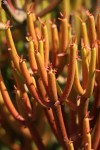
Photo: Mark Hyde
Blue Kerry, Harare
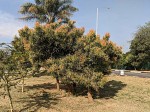
Photo: Mark Hyde
Bond Street shops, Mount Pleasant, by The Chase
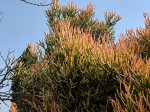
Photo: Mark Hyde
Bond Street shops, Mount Pleasant, by The Chase
Detailed records: Display species records QDS maps by: Google Maps Point records by Google Maps
Species details: Click on each item to see an explanation of that item (Note: opens a new window)
| Synonyms: |
Euphorbia media N.E. Br. Euphorbia media N.E. Br. var. bagshawei N.E. Br. Euphorbia rhipsaloides N.E. Br. Euphorbia scoparia N.E. Br. |
| Common names: | Hejiyemukaka (Shona) Ingotsha (Ndebele) Pencil cactus (English) Rubber euphorbia (English) Rubber hedge plant (English) Rusungwe (Shona) |
| Frequency: | Frequent |
| Status: | Probably introduced, but a frequent relic of cultivation and sometimes naturalised. |
| Description: |
Unarmed, succulent shrub to 5 m, or a small tree to 12 m, with brittle succulent branches which are often whorled, c.7 mm thick, green with fine longitudinal white striations. Leaves few, linear-lanceolate to narrowly obovate, fleshy, present only on new growth and quickly deciduous. Cymes 2-6, congested at apices of branchlets, forking 2-4-times, producing cyathia, these usually either all male or all female. Cyathium c.3 × 4 mm; glands to 1.5 × 2 mm, 5, subspherical to transversely elliptic, bright yellow; lobes c.0.5 mm, triangular. Capsule c.8 × 8.5 mm, subspherical, glabrescent, exserted on a tomentose pedicel. Seeds 3.5 × 2.8 mm, ovoid, smooth. |
| Type location: |
Lectotype from Sri Lanka |
| Notes: | Very commonly planted throughout Zimbabwe, but especially in Communal Lands as a toxic, goat-resistant hedge. |
| Derivation of specific name: | tirucalli: from a name used by the inhabitants of Malabar, a region of southern India. |
| Habitat: | Open woodland; very frequently planted and naturalising near habitation. |
| Altitude range: (metres) | Up to 1550 m (approx) |
| Flowering time: | Oct - Dec |
| Worldwide distribution: | Widespread in tropical Africa, the Arabian Peninsula, Madagascar, India and the Far East. |
| FZ divisions: | N,W,C,E,S |
| Growth form(s): | Tree, shrub over 2 m, shrub under 2 m. |
| Endemic status: | |
| Red data list status: | |
| Insects associated with this species: | |
| Spot characters: | Display spot characters for this species |
| Literature: |
Burrows, J.E., Burrows, S.M., Lötter, M.C. & Schmidt, E. (2018). Trees and Shrubs Mozambique Publishing Print Matters (Pty), Cape Town. Page 456. (Includes a picture). Carter, S. & Leach, L.C. (2001). Euphorbiaceae: subfamily Euphorbioideae: tribe Euphorbieae Flora Zambesiaca 9(5) Pages 391 - 392. Curtis, B.A. & Mannheimer, C.A. (2005). Tree Atlas of Namibia National Botanic Research Institute, Windhoek Page 639. Drummond, R.B. (1975). A list of trees, shrubs and woody climbers indigenous or naturalised in Rhodesia. Kirkia 10(1) Page 253. Heath, A. & Heath, R. (2009). Field Guide to the Plants of Northern Botswana including the Okavango Delta Kew Publishing Page 90. (Includes a picture). Mapaura, A. & Timberlake, J. (eds) (2004). A checklist of Zimbabwean vascular plants Southern African Botanical Diversity Network Report No. 33 Sabonet, Pretoria and Harare Page 41. Ntore, S. & al. (2024). Checklist of the vascular plants of Burundi Page 109. Parker, T. (2023). Common Trees of Mozambique The Tree Press, Austin, Texas, USA Pages 142 - 143. (Includes a picture). Setshogo, M.P. (2005). Preliminary checklist of the plants of Botswana. Sabonet Report no. 37. Sabonet, Pretoria and Gaborone Page 57. Siebert, S. & Mössmer, M. (Editors) (2002). SABONET Southern Mozambique Expedition 2001; Provisional Plant Checklist of the Maputo Elephant Reserve (MER) and Licuati Forest Reserve (LFR) SABONET News 7(1) Page 25. Troupin, G. (1983). Euphorbiaceae Flore du Rwanda Spermatophytes Volume II Page 226. |
Other sources of information about Euphorbia tirucalli:
Our websites:
Flora of Botswana: Euphorbia tirucalliFlora of Botswana: cultivated Euphorbia tirucalli
Flora of Burundi: Euphorbia tirucalli
Flora of Caprivi: Euphorbia tirucalli
Flora of Malawi: Euphorbia tirucalli
Flora of Mozambique: Euphorbia tirucalli
Flora of Mozambique: cultivated Euphorbia tirucalli
Flora of Rwanda: Euphorbia tirucalli
Flora of Zambia: Euphorbia tirucalli
Flora of Zimbabwe: cultivated Euphorbia tirucalli
External websites:
African Plants: A Photo Guide (Senckenberg): Euphorbia tirucalliAfrican Plant Database: Euphorbia tirucalli
BHL (Biodiversity Heritage Library): Euphorbia tirucalli
EOL (Encyclopedia of Life): Euphorbia tirucalli
GBIF (Global Biodiversity Information Facility): Euphorbia tirucalli
Google: Web - Images - Scholar
iNaturalist: Euphorbia tirucalli
IPNI (International Plant Names Index): Euphorbia tirucalli
JSTOR Plant Science: Euphorbia tirucalli
Mansfeld World Database of Agricultural and Horticultural Crops: Euphorbia tirucalli
Plants of the World Online: Euphorbia tirucalli
Tropicos: Euphorbia tirucalli
Wikipedia: Euphorbia tirucalli