Flora of Zimbabwe: Cultivated plants
Amphilophium crucigerum
Selected images: Click on each image to see a larger version and details of the record View all images (9)
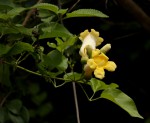
Photo: Bart Wursten
Along roadside on hill behind La Rochelle Hotel
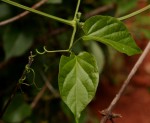
Photo: Bart Wursten
Along roadside on hill behind La Rochelle Hotel
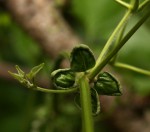
Photo: Bart Wursten
Along roadside on hill behind La Rochelle Hotel
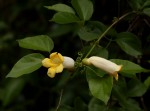
Photo: Bart Wursten
Along roadside on hill behind La Rochelle Hotel
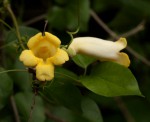
Photo: Bart Wursten
Along roadside on hill behind La Rochelle Hotel
Records: Display species records Map species using Google Maps
Species details: Click on each item to see an explanation of that item (Note: opens a new window)
| Synonyms: |
Pithecoctenium crucigerum (L.) A.H. Gentry Pithecoctenium echinatum (Jacq.) Baill. |
| Common names: | Monkey comb (English) |
| Description: | Perennial climber. Leaves 2–3-foliolate, terminal one often replaced by a tendril; leaflets ovate or subcircular, 3.3–18 cm long, cordate at base; petiole 3–7 cm long. Inflorescences terminal, up to 15-flowered. Calyx 8–12 mm long. Corolla white with yellow throat, tubular-campanulate, 3.5–6 cm long often with 90° bend in middle of tube. Fruit oblong to ellipsoid, 24–31 cm long, echinate. Seeds winged. |
| Notes: | Commonly cultivated in gardens. The species was originally included as a possibly naturalised plant on rather slender evidence. Meanwhile it has been recorded from various places where it appears to become invasive, such as disturbed woodland near La Rochelle Hotel; montane and riverine forest in the Vumba; around the campsite and chalets in Chirinda Forest and in riverine fringes near Arcturus. These records are an indication that this species could eventually, if not controlled, become a serious invader in Zimbabwe. |
| Derivation of specific name: | |
| Flowering time: | |
| Worldwide distribution: | Native from Mexico to Argentina and in the West-Indies. |
| Growth form(s): | Climber, liane. |
| Insects associated with this species: | |
| Spot characters: | Display spot characters for this species |
| Image last updated: | Saturday 8 October 2011 |
| Literature: |
Bidgood, S., Verdcourt, B. & Vollesen K. (2006). Bignoniaceae and Cobaeaceae Flora of Tropical East Africa Royal Botanic Gardens, Kew Page 14. As Pithecoctenium crucigerum |
Other sources of information about Amphilophium crucigerum:
Our websites:
Flora of Zimbabwe: Amphilophium crucigerumExternal websites:
African Plants: A Photo Guide (Senckenberg): Amphilophium crucigerumAfrican Plant Database: Amphilophium crucigerum
BHL (Biodiversity Heritage Library): Amphilophium crucigerum
EOL (Encyclopedia of Life): Amphilophium crucigerum
GBIF (Global Biodiversity Information Facility): Amphilophium crucigerum
Google: Web - Images - Scholar
iNaturalist: Amphilophium crucigerum
IPNI (International Plant Names Index): Amphilophium crucigerum
JSTOR Plant Science: Amphilophium crucigerum
Mansfeld World Database of Agricultural and Horticultural Crops: Amphilophium crucigerum
Plants of the World Online: Amphilophium crucigerum
Tropicos: Amphilophium crucigerum
Wikipedia: Amphilophium crucigerum