Strychnos innocua
Selected images: Click on each image to see a larger version and details of the record View all images (7)
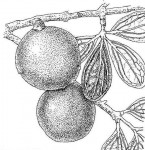
Drawing: Rita Herbert
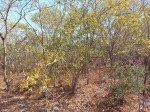
Habit
Riverine forest margin
Mbita (Kumbula) Island, Mpulungu, Mpulungu Distr.
Aug 2022
Photo: Nick Wightman
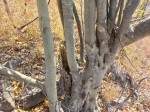
Bark
Escarpment miombo woodland
Mpulungu Harbour, Mpulungu, Mpulungu Distr.
Aug 2022
Photo: Nick Wightman
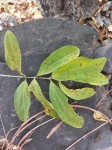
Leaf top
Escarpment miombo woodland
Mpulungu Harbour, Mpulungu, Mpulungu Distr.
Aug 2022
Photo: Nick Wightman
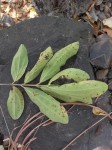
Leaf bottom
Escarpment miombo woodland
Mpulungu Harbour, Mpulungu, Mpulungu Distr.
Aug 2022
Photo: Nick Wightman
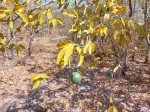
Leaves and Fruit
Riverine forest margin
Mbita (Kumbula) Island, Mpulungu, Mpulungu Distr.
Aug 2022
Photo: Nick Wightman
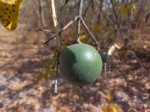
Fruit
Riverine forest margin
Mbita (Kumbula) Island, Mpulungu, Mpulungu Distr.
Aug 2022
Photo: Nick Wightman
Detailed records: Display species records QDS maps by: Google Maps Point records by Google Maps
Species details: Click on each item to see an explanation of that item (Note: opens a new window)
| Synonyms: |
Stychnos unguacha A.Rich. |
| Common names: | Powder-bark monkey-orange (English) |
| Frequency: | |
| Status: | Native |
| Description: |
Unarmed small tree to 6 m. Bark grey to grey-brown, smooth, somewhat powdery, the powder easily rubbing off. Leaves: lamina elliptic to obovate, 4-10 × 2-7 cm, dull green, almost concolorous with conspicuous pale net-veining on both surfaces. Flowers in 2- or 4-flowered heads in axillary clusters, greenish-yellow to cream. Fruit ± spherical, 4-7.5 cm in diameter, bluish-green turning yellow. |
| Type location: |
Ethiopia |
| Notes: | |
| Derivation of specific name: | innocua: harmless, referring to the lack of spines |
| Habitat: | In open woodland and on rocky hills. |
| Altitude range: (metres) | |
| Flowering time: | Sep - Nov |
| Worldwide distribution: | Widespread from West Africa to East Africa south to Angola, Zambia, Zimbabwe and Mozambique |
| FZ divisions: | N,C,E,S |
| Growth form(s): | Tree. |
| Endemic status: | |
| Red data list status: | |
| Insects associated with this species: | |
| Spot characters: | Display spot characters for this species |
| Literature: |
Burrows, J.E., Burrows, S.M., Lötter, M.C. & Schmidt, E. (2018). Trees and Shrubs Mozambique Publishing Print Matters (Pty), Cape Town. Page 775. (Includes a picture). Drummond, R.B. (1975). A list of trees, shrubs and woody climbers indigenous or naturalised in Rhodesia. Kirkia 10(1) Page 268. Leeuwenberg, A.J.M. (1983). Loganiaceae (inc. Buddlejaceae) Flora Zambesiaca 7(1) Pages 361 - 362. Leeuwenberg, A.J.M. & Bamps, P. (1979). Loganiaceae Flore d'Afrique Centrale (Zaire - Rwanda - Burundi) Jardin Botanique National de Belgique Pages 91 - 94. (Includes a picture). Mapaura, A. & Timberlake, J. (eds) (2004). A checklist of Zimbabwean vascular plants Southern African Botanical Diversity Network Report No. 33 Sabonet, Pretoria and Harare Page 58. Meerts, P. & Hasson, M. (2016). Arbres et arbustes du Haut-Katanga Jardin Botanique Meise, Belgique Page 203. (Includes a picture). Ntore, S. & al. (2024). Checklist of the vascular plants of Burundi Page 154. Siebert, S. & Mössmer, M. (Editors) (2002). SABONET Southern Mozambique Expedition 2001; Provisional Plant Checklist of the Maputo Elephant Reserve (MER) and Licuati Forest Reserve (LFR) SABONET News 7(1) Page 26. Smith, P. & Allen, Q. (2004). Field Guide to the Trees and Shrubs of the Miombo Woodlands Royal Botanic Gardens, Kew ISBN 1 84246 073 0 Pages 42 - 43. (Includes a picture). Strugnell, A.M. (2006). A Checklist of the Spermatophytes of Mount Mulanje, Malawi Scripta Botanica Belgica 34 National Botanic Garden of Belgium Page 117. Troupin, G. (1985). Loganiaceae Flore du Rwanda Spermatophytes Volume III Page 54. (Includes a picture). |
Other sources of information about Strychnos innocua:
Our websites:
Flora of Burundi: Strychnos innocuaFlora of the DRC: Strychnos innocua
Flora of Malawi: Strychnos innocua
Flora of Mozambique: Strychnos innocua
Flora of Rwanda: Strychnos innocua
Flora of Zambia: Strychnos innocua
External websites:
African Plants: A Photo Guide (Senckenberg): Strychnos innocuaAfrican Plant Database: Strychnos innocua
BHL (Biodiversity Heritage Library): Strychnos innocua
EOL (Encyclopedia of Life): Strychnos innocua
GBIF (Global Biodiversity Information Facility): Strychnos innocua
Google: Web - Images - Scholar
iNaturalist: Strychnos innocua
IPNI (International Plant Names Index): Strychnos innocua
JSTOR Plant Science: Strychnos innocua
Mansfeld World Database of Agricultural and Horticultural Crops: Strychnos innocua
Plants of the World Online: Strychnos innocua
Tropicos: Strychnos innocua
Wikipedia: Strychnos innocua